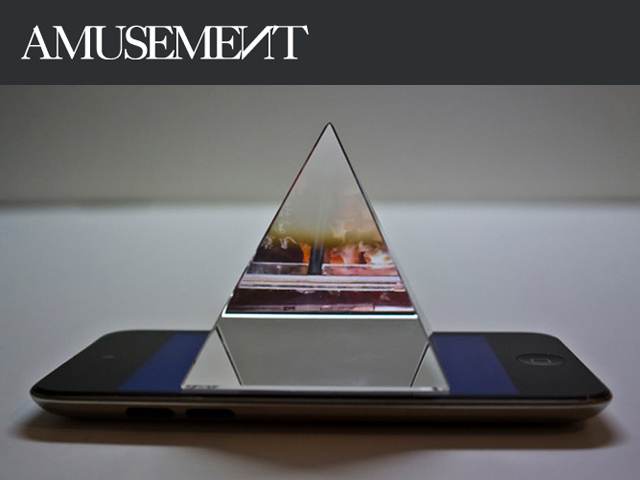
In the duration of the preceding experimental stage, my main focus was on generating the concept and creating a prototype, in addition to test various visual effects that can be achieved through a pyramid shaped prism from motion picture sequences played in an ipod touch.
In this second stage of the research, my primal goal is to firstly, upgrade the actual content of the motion picture (animation) by adopting elements of the projects that would be executed during the course, Emergent Media One. Finally, to regenerate the prototype for my final presentation at the degree show scheduled in late December, 2012 in Seoul, Korea.
On that note, I plan to proceed with the following carte;
A. Computer generation of motion pictures
>> STYLE ONE: Symbolic graphics (Typography)
>> STYLE TWO: Nonfigurative graphics
B. Device and Space design
>>STAGE ONE : Prototype regeneration ( with additional devices/functions)
>>STAGE TWO : Exhibition / Space design for the purpose of visual art and new media
Reference: Independent Study II research blog >> Anotes
The above video shows the final test results of the project, currently titled as ひかりの標本 (Hikarino Hyohon) / Luminous Specimen.
Although the course work for the semester has come to the end, I plan to further develop this project for the upcoming semester to conclude my thesis work. On that note, please keep visiting this blog for more updates.
Above images show the results of my four prism tests. Upon observing from various angles, how different types of glass prisms would present the same motion picture, it seemed as though the pyramid shaped prism (bottom left) demonstrated the best results.
This experiment is the sequel test to Prismpod test 001* For this test, I replaced the rectangle prism with triangle one. Personally, I felt as though that this shape created far more interesting reflection comparing to the prior, however, I would like to further experiment with a dorm shaped as well as a triangle with 4 reflecting surfaces.
I run a quick test to see how a motion picture playing on a LCD screen would look through a prism.
On that note, I followed the same procedure as my first Prismpod test, however, this time, I placed a video footage inside of the rectangle.
Upon attempting to capture the moving images from various angles, this exact position was the most I could observe the interesting reflection created by the prism. In that sense, this rectangular shaped prism may not be cut out for the intended light installation.
Last but not least, I would like to note the solution for the technical difficulty that I encountered while exporting the base video to iPod, so I won't repeat that struggle ever again. (It was rather sluggish of a media student, it took me a while to figure out converting the video to play correctly on the iPod.) When I tried to import footage (both H.264 and MOV.) straight from my computer to the device, iTune constantly gave me an error message saying "cannot be played on this ipod." After a numerous trials and errors, I came upon a method that worked the best for this particular case; Export the 960×640 footage as MOV. format > Open it with Quick Time Player > Under "Share" manu, choose iTune > import the footage to iPod
I created a kaleidoscope, in order to experiment with multiple mirror effect, as well as symmetrical oscillation patterns that could be created by it.
A kaleidoscope is a tube-shaped optical instrument with a rotating end piece, which contains loose, colored objects. It was initially invented by Scottish inventor, David Brewster, as a scientific tool for the study of polarized light and later copied as a toy.
The tube is commonly constructed with three rectangular mirrors, therefore, I constructed a triangular tube with 3 slices of rectangle-shaped cardboard with mirror stickers on, and placed various colorful objects, such as rubber bands, circuit strings, prisms, gummy bears and glitter glues, on one side of the tube. On that note, the above images show the result of what I observed when I looked through to one end of the tube, where the objects were placed. More precisely, I saw the light entering the other end of the tube and the objects inside were presented as colorful, geometric patterns due to the reflections in the mirrors. Twisting the end piece made the objects tumbled and resulted in further presenting varieties of color and patterns.
In conclusion, this visual effect resulted in generating the idea of ひかりの標本 (Hikari no hyohon), which is Japanese for “luminous specimen”; sealing light source inside of a prism as if it were a specimen. On that note, my next step is to utilize my initial concept of replacing the physical light with digital media solution to design a mock-up, which will be constructed with a prism attached to a LCD screen, and the animation is projected on the prisms’ surfaces from behind.




 Posts
Posts


